Add your email below for new posts to be sent to you by email.

Saturday, 2 August 2014

Impressions of Greece

We were in Greece for just one short week, far too short for this beautiful country.  We arrived in Kefallonia early one morning and stood off in a glassy sea until daybreak before entering the picturesque gulf of Argostoli.  
Now, instead of seeing Genoese forts as we saw all over Sardinia and Sicily and Corsica, we saw little churches on the headlands, perhaps a better use of the land.  The lighthouse at the head of the bay is built as an ancient Greek temple, a thalos.  We knew that we were in Greece.


 For the first time during our travels we needed to drop anchor and reverse back onto the quay to tie up, not an easy feat with our Island Packet that does NOT like to reverse!  Now however, we are becoming much more skilled at this manoeuvre. We tied up in Argostoli, on the town quay and found everything we needed close at hand – yacht chandler, supermarket etc. 

The Greeks are so friendly.  Everyone has been so helpful and kind, at the restaurant when the waiters serve you food they wish you “good appetite”, when they serve alcohol they wish you “good health” and whenever you say “Thank you” they wish you  “Remain well”.   The Ionian islands where we sailed are still unspoilt.  They are surprisingly green, and have high hills with little villas dotted about the slopes, built among cypress and olive trees.  The villages are small, with very few modern buildings, have winding narrow roads and often an old Roman ruin nearby to walk to. 


At Agia Efimia on Kefallonia, we went for a walk out of the village. We met a lady moving rocks about outside her property on the outskirts of town and stopped to ask directions. We were invited into her home and had a lovely cup of Greek coffee and a chat with her and her sister.  The financial crisis has hit Greece very hard. Greece’s major source of income is tourism but we saw few tourists, especially on the more remote islands.  There was also always plenty of space for us to tie up on the quays, which means that the charter boat industry must also be suffering.  On Ithaca, Odysseus’ island, the ferry from the mainland has stopped running and this has made the problem even worse for them.  They have tried to keep  their capital, Vathi,  unspoilt.  I saw some photos from the 1920’s and it still looks exactly the same! 
There are lots of beautiful little bays and fjords in these isles, with lovely, peaceful (and still) anchorages.  

Each has a little village or, if nothing else, a restaurant at the head of the bay, so there is always somewhere to stock up and get a meal of delicious “home cooked’ food.  Most of these restaurants are family run and “Mamma” is usually the cook in the kitchen.


Kerkyra (Corfu) is Unesco Heritage listed.  The old town is very beautiful, with marble cobbles.  It is on a peninsula, with an Old Fort at one end and a New Fort at the other. The older one is still being used by the navy.  We wandered the little streets and the many parks surrounding the old town.  It also has a working moat, now used to harbour little fishing boats.   Here we did see many tourists.  The town is bustling and the restaurants are full.  Dinner time here is around 10pm. and goes on till late – just about till dawn!  Even with all the tourists, the friendliness we have found was not lacking here either. We checked out of Greece early in the morning (after a chat with the customs officer)  and as we left Kerkyra, knowing that we would certainly be back,  the large Customs launch came speeding past.  They saw me on the front deck and gave me a farewell toot and handwave.


Wednesday, 23 July 2014

Travels in Sardinia and Sicily


We set sail from Porto Liscia to the little town of Santa Teresa, on the northwest coast of Sardinia. The marina was a pleasant place to be, at the end of the inlet.  The little town is built on the top of a steep hill with wonderful views and a cooling sea breeze. It too has its Genoese watch towers which guarded against corsairs in the old days, at the entrance to the inlet.  

Isola Rossa, our anchorage for a night proved to be quite a challenge.  After a very still afternoon, which enabled us to swim, snorkel, go to shore for a meal and a wander, the wind came up, bringing  a large swell rolling into the bay. It became quite a challenge to get into the dinghy and attach lines to lift it.   It proved an uncomfortable night with athe beam swell determined to keep us awake!

The walled town of Castelsardo is a  wonderful sight from the sea.  It is a medieval town built on a steep hill, with the houses piled one on top of the other, tumbling down the cliff.  There is a cathedral with a belfry and a castle at the top of the hill. A Genoese watchtower dominates the entrance to the port. We made some friends in the marina and had a lovely evening eating and playing music on one of the boats as our guest “jammed” with our new friends,. The  sun setting over this beautiful Medieval setting afforded us an opportunity for some lovely pictures.


We took a route between the Sardinian mainland and Isola Asinara, a marine national park,  through the narrow and very shallow Passaggio Del Fornelli.  The water was beautiful aquamarine in the channel.  From here we could see the high security prison on the island where many characters involved in Italian organized crime were incarcerated. A sailing vessel had run aground here but fortunately managed to get itself back into deeper water.


Through the passage we went on began our journey down the west coast of Sardinia. It  is very steep with majestic cliffs, wonderful rock formations and numerous caves. Grotta Di Nettuno is a very popular destination for daytripper boats. We sailed past at sunset, just before entering Porto Conte, a large bay where we anchored for the next two nights.  This bay is one of the few along the west coast of Sardinia which offers safe shelter., though a southerly did come through here one night and we dragged our anchor 1nm. before we realized it!  Fortunately there are no dangers in the bay and plenty of space but we did have to re-anchor at 1a.m. in the morning. The only down-side to this idyllic back is the disco bar on the shore which blasts very loud music across the bay till 4a.m. In fact, we were beset with loud music at many of the Sardinian spots which appeared very peaceful during the day.

Alghero is a bustling town on the north west coast of Sardinia.  It too has a walled Medieval old town and here we began to see tourists.  Friends arrived by air to spend two weeks with us and we had some good Sardinian food and wine at a restaurant in the old town.  At our marina we met Federico, typical of the friendliness we have found on our travels.  He was happy to give us a lift to the supermarket, collect guests from the airport and take us to Coast Guard and Customs to do our  necessary paperwork.

Our next stop turned out to be a disappointment.  We went into the Golfo Di Oristano and anchored off the small village of Torre Grande, named after their large Genoese tower in the centre of the village. Although the bay appeared to be very peaceful, we were once again blasted by disco music until 3am.  As a result we decided to give the Roman ruins on the shore a miss and move on to a quieter place.

We made for the small island of San Pietro, off the southwest coast of Sardinia.  The main town, Carloforte was a delight, with its tree-lined waterfront, small 17th century laneways and delicious food.  We took a bus to a beach on the west coast of the island. It was, as are most beaches in Europe, very typical, with it’s beach chairs,, umbrellas and beach bars. The countryside we rode through is typical of Sardinia, being fairly dry with many lovely Oleanders and Bougainvilleas on the way.

Carloforte was our jump-off point to make for Sicily, 234nm away. We had headwinds all the way and took quite a bit of water over the front deck.   We arrived at San Vito Lo Capo late in the evening of the second day and anchored out for the night.  A friendly lighthouse on the Cape kept us company for the night. The houses in San Vito Lo Capo are white and look very Moorish.  We noticed that the flavor of the food had also changed, being more spicy than we had found in Sardinia.

Castellammare Del Golfo, was our next stop. The entrance to the harbour is dominated by a large ancient castle.  The Medieval town is built high on the hill and it is quite a challenge to climb up to the town. There is a cool breeze up at the top, making it a very pleasant time in summer.  We decided to take a bus to Segesta to see the Doric temple and ancient village on the top of a steep hill with a wonderful intact Roman theatre. From here, one can see for miles over green undulating valleys, all the way to the sea.  Our bus back to Castellammare Del Golfo was due at 12.30p.m.  By 1p.m. it had not arrived and the next bus was only at 6p.m.  At 1.05p.m. the bus arrived and the driver told us that another bus had had a problem and he had had to incorporate the second route into his.  We were happy that he arrived though and were even happier when he dropped us at a delightful stone village for a lovely Sicilian lunch under the grape vines.

We dropped our guests off in Palmero and from there visited the small town of Cefalu, on our way to the Isole Eoli. Cefalu has an ancient temple to Diana on the very top of a steep hill and below a walled Medieval citadel. Tourists have discovered this quaint village and as a result, it has many upmarket shops and restaurants. It is very pleasant to wander through the little cobbled streets and alleyways.   The yacht harbour is also a walk around the headland from town so the night was wonderfully quiet and we sat under the stars for a nightcap before bed.


Lipari, the island in the middle of the Eolian Islands has  the largest population of this volcanic group.. We sailed past the island of Vulcano and could see the steam which continuously belches out of the caldera. Vulcano has three volcanos on it.  Only Gran Cratere is still active.  The little town of Vulcano nestles right under it!  From our marina in Lipari, we had a view of this crater. It is a pity we cannot harness this power for our energy needs.   The next day we sailed to Stromboli, the island which has an active but “safe” volcano on it. We anchored on the “safe” side of the island and the evening was spent watching filming of an Italian movie on a nearby sailing Superyacht. At midnight we lifted our anchor and motored round to the west coast to see the eruptions. The volcano releases its pressure bit by bit so does not pose a very great danger. It erupts every five minutes or so. It sprays lava up into the air in a spectacular fireworks display, and from the crater there is a river of lava, the sciara del fuoco,  flowing into the sea. Stromboli was used by Ulysses to guide him to the  Straits of Messina and it is known as the oldest lighthouse in the world.

The Straits of Messina, another of the destinations of Ulysses, with Charybdis the whirlpool and Skilla, the monster with twelve feet and six long necks with terrible heads which plucked sailors off their boats, was our next destination.  Although the whirlpools, of which there are three today, no longer pose a great problem to sailors since the 1783 earthquake which changed the undersea topography, this is still a place to beware of.  The Tyrrhenian and Ionian seas which meet here have different heights and salinity and there is a current which runs through the mouth of the Strait at  4kn. at times.  There is a bore just after the change of tide four times a day as well.  In addition there are strong katabatic winds off the mountains (Skilla) and it is not a place to be in a small boat with strong wind against tide. We had an uneventful ride through the strait.  We did skirt around a whirlpool and went over a small bore which caused us to slew sideways but fortunately we had very light wind, that is, until just before we entered the harbour  at Reggio de Calabria, when it suddenly started blowing 20kn. We were in the industrial port area, but met a local character, Saverio, who is the “Mr. Fixit” of  the marina.  We will arrange supplies, assistance, runs a “Mini Moke” taxi, and he supplied us with cheese, salami, croissants and a taxi ride to a pleasant trattoria. He has been doing this for over 20 years, and knows everyone!
We sadly said farewell to Italy at Reggio de Calabria and set sail  for  Greece in a brisk 15kn. wind.


Monday, 23 June 2014

20th June 2014

We caught a bus back to Ajaccio to drop a guest off and collect another.  We were delayed in Ajaccio as we had arrived on the Saturday bus and there was no Sunday bus to return with. We arrived at the bus stop on the Monday with bags in tow, only to find that it was yet another holy holiday and there was no bus till the Tuesday! Ajaccio was the birthplace of Napoleon Bonaparte and a group of locals got into the spirit and were meeting near Napoleon’s home.  They took delight in parading up and down the street, posing for tourists to take  photos.


Near the home that Napoleon Bonaparte was born in

We finally managed to get a bus back to Bonifacio.   The bus winds through hilltop villages which all seem to have been built with defence in mind.  Many of the old parts of the villages were walled and some had brooding castles overlooking the valley below.  Life would have been very hard in this part of the world a few centuries ago and even at the beginning of the 19th century there were many bandits in Corsica. The coastline is also dotted with Genoese watch towers which were built to warn of approaching corsairs raiding from Africa! The flag of Corsica (& Sardinia) actually have the black heads of the corsair captains who were caught, beheaded and their heads taken back in the flag. Gruesome, but it makes a great flag and since there are no longer any Corsairs, the warning has worked!


Bonifacio at night


Artemis V in Bonifacio Harbour

Bonifacio town on overhanging cliffs


From Bonifacio, we went to Iles Lavezzi.  These rocky outcrops have been declared a heritage listed national park.  We anchored in a bay with crystal clear water.  It is so clear that you can select exactly which patch of sand to put the anchor on. There were lots of fish there, a delight to see in the Mediterranean.  On the island are approximately 600 graves and a little chapel. On the way to the Crimean War, a ship floundered there and all lives were lost. Only one person witnessed the tragedy, a leper living on his own on the island. The bodies were so mangled when they were pulled from the sea that only one person could be identified. All the other graves are unmarked. 


Cemetry on Ile Lavezzi


Anchorage at Iles Lavezzi

From Iles Lavezzi we crossed the Bonifacio Strait to the La Maddalena Islands which are also national park. This crossing marks the border between France and Italy, just 5nm. apart.  These islands, like Iles Lavezzi, are all fringed with rocks and shoals.  Disappointingly we have not seen many fish amongst these islands. 

Crossing the Bonifacio Strait from France to Italy.

   The little town of La Maddalena was a delight however and we spent several days there, wondering the streets, eating, drinking and catching up with news from family and friends.


Port of the town of La Maddalena

For the last two days we have been anchored in Porto Luscia Bay, on the Sardinian mainland.  There is a kitesurfing school and a windsurfing school in the bay and it has been fun watching them fly across the water in the brisk breeze that always seems to blow in the Bonifacio Strait.  The bay is very quiet, with long empty beaches and a national park behind.  Each day there have been only two or three other boats anchored nearby and it is very peaceful. This morning we woke to the timeless sounds of a sheepdog and sheep bells on the hill close by.


Porto Luscia Bay

Sunday, 8 June 2014

8th June 2014

We have slowly been making our way down the west coast of Corsica, stopping for a few days here and there in little anchorages or in marinas.  We left Calvi on a sunny morning, making for the picturesque village of Girolata.  This village is on a headland, overlooking the ocean. The headland has a wonderful old fort guarding the entrance to the little cove in which  the Genoese, in old times, used to shelter their little ships and in which we took a mooring buoy. The village has only ten permanent residents and the only access is via hiking paths or by boat. Many boat trippers arrive on a daily basis in the summer so there are five beachside restaurants there.


The whole area around the village is national park and heritage listed and is very pretty.


From there we moved on to the little town of Sagone.  We anchored off the beach and, unusually for the Mediterranean, we had the place all to ourselves for two days.  There we saw the ruin of an early Christian cathedral. It is unusual as it has two menhirs as the foundation cornerstones. It is thought that this was to symbolize the triumph of the new Christian religion over the old pagan one. We had a lovely picnic lunch under the trees  with little swallows  above for company.


 There are many Genoese watch towers on headlands all along the coast.  These were built in middle ages to protect Corsica from the corsairs who constantly raided the coastal villages.
 Ajaccio is the capital of Corsica and we were expecting a bustling European city.  To our surprise we found it to be relatively small and sleepy. Since it was Saturday, we decided to see what entertainment the town offered. We left the boat at 9pm. only to find that everything was already closed. The only thing on in town was an open-air band playing traditional Corsican folk music.
We were told that the scenery of the hinterland is pretty spectacular so we decided to take a ride on the train which runs between Ajaccio and Calvi.  It winds through many mountain villages and goes through several mountain ranges.  The mountains are very high and still snowcapped. Most of Corsica seems to be uncultivated and the scenery was indeed beautiful.


We  anchored off the little village of Porto Pollo.  We did a 14km. round trip walk to the village of Filitosa, the 8,000 year old ancient capital of Corsica.  This prehistoric place has stone menhirs which were probably intended to frighten their enemies. There were numerous prehistoric rock shelters and above them, medieval stone houses. We had yet another picnic lunch, this time amongst the menhirs and ancient olive trees.
From Porto Pollo we moved to a beautiful little cove called Anse de Roccapina.  The headland there looks like a huge lion, the beach is lovely white sand and the water is crystal clear.  We fed some very hungry fish which were sheltering in the shadow of our boat. In fact, on the way there our depth sounder kept reading very shallow water, around 4m when we knew we were in about 100m.  We eventually realized that it must have been a school of fish following us, probably for protection from something larger below them. The area around this cove is unspoilt and we ventured into the water for a swim as it was so tempting.  It was still rather cold at 16 degrees C!


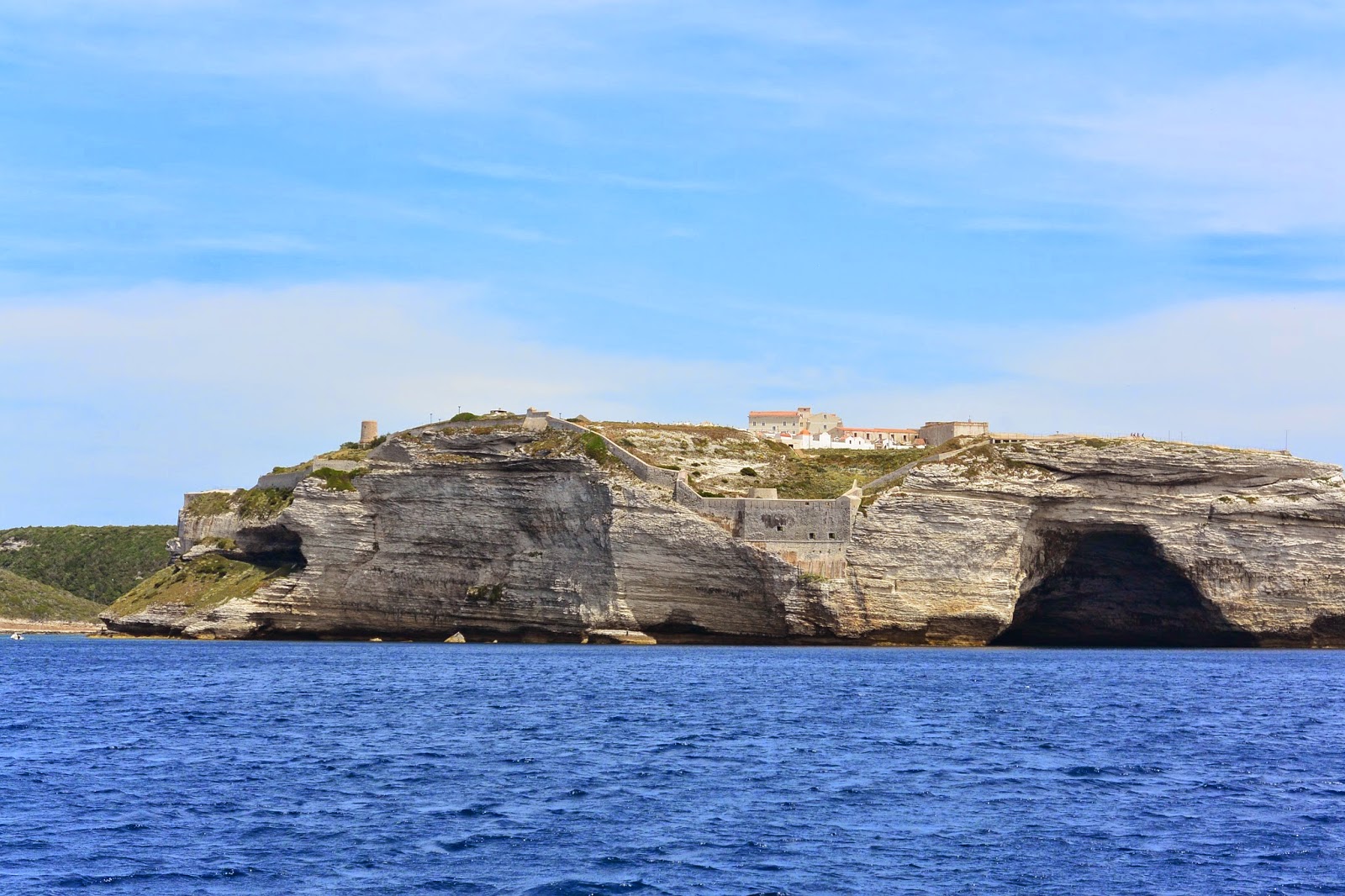
Bonifacio at the southern tip of Corsica is spectacular.  The village hangs over the edge of overhanging cliffs which have been eroded with time. There are some very large caves at sea level.  The town is on a large spit of land and the entrance to the harbour is a very narrow channel  about 1nm long, hemmed in on both sides by high cliffs. There is an impenetrable looking fortress at the top of the cliff, which protected Bonifacio from the Corsairs in the old days.  This is a natural harbour described in Homer’s Odyssey.  Legend has it that Odysseus went there and sent two of his men into the harbour.  One was torn apart and eaten on the spot and the other was killed while trying to get his ship back out!  


Friday, 30 May 2014

22/5/2014

Yesterday we folded up and packed our bikes and took the opportunity of no wind last night to get our sails up. Here is our bike garage, while we were “on the hard”.

 We collapsed into bed at 1am. only to be woken at 6am. by the boat-lift’s arrival.  Artemis V was put into the water without any mishaps and she seemed happy to be there, jiggling her bottom as she touched the water.


 We departed Barcelona soon thereafter, having finished all our maintenance tasks and ready for a summer holiday.  We took leave of “Eclipse” who was moored just a little way from us, having major work done.  She is the world’s second largest private yacht, belonging to Mr. Abramowitz, the Russian oil magnate.  She is 535ft. long with a beam of 76ft. Her tender dinghy is longer than we are!  Mr. Abramowitz has bought Port Velle Marina, the most expensive marina in Spain and has gutted it, just so that he can keep his boat there.  We stayed in that marina when we first got to Barcelona last year, but now all the docks are gone and only superyachts remain.


   About an hour outside Barcelona, looking to the south, we could see a sandstorm coming across from the African coast.  It was a yellow band stretching right across the horizon and rising up several hundred feet into the sky.  Several times while in Barcelona we had woken to find the boat covered in reddish/yellow sand from the African deserts.  This is something one would expect in the Australian Outback, not out at sea!
We have had a beautiful afternoon’s sail, the wind is blowing around 16kn. on the beam, the sun is out, there are white caps painted on the blue sea and the Spanish coast is gradually disappearing into the distance.  We have also seen quite a few fishing and cargo vessels today, either on their way to or from, Barcelona.
23/5/2014
This morning around 10am we were buzzed by two Mirage fighter jets.  They came in fast and low and were just about on top of us before we heard them.  They really gave us a big fright. They did a circuit and then waggled their wings and were gone. Around lunchtime a little refugee arrived.  A  turtle dove landed on our rail and he has been with us all through the afternoon.  I have tried giving him bread and water but he will not have any. I guess that if he stays, he will arrive in Corsica with us!  There has been some very serious wind in the Gulf of Leon and perhaps he was blown far south.  Hopefully he will stay through the night as we are still 100nm  (close on 200km) from land.  He is sitting on our gennoa sheet and I don’t want to disturb him so I won’t let Dimitri put that sail out. Dimitri says that will cost us $100 in extra fuel – c’est la vie.


24/5/2014
. This morning, the sea was covered in blue-bottles as far as the eye could see.  It looked as though it was covered with bubbles. The turtle dove stayed with us all the way to Corsica. The last leg of the trip, he spent warming his toes on the solar panels – it was still pretty cold out there.  He stayed till the very end, only flying off as we rounded the Citadel, just above the marina.   As we approached land, we came upon high jagged peaks, with the highest of them still covered in snow.  

Tuesday, 20 May 2014

We left Sydney on a sunny Sunday morning, bound for Paris.  We decided to stay in a non-tourist area of the city and chose Montparnasse.  Around the corner was a wonderful cemetery, with both very old and very new graves.  We were fascinated by some most unusual gravestones.  We went to the local street market and bought some of the local produce and a necessary jacket for Dimitri as the fresh spring Paris air was not what we had expected. We enjoyed going  to a  “cave” one evening – basically an old torture chamber dungeon which is now used as a  jazz dive- and saw some awesome ballroom dancing by members of the crowd during the jazz breaks.

We reached Barcelona on 7th May and Artemis V was a very welcome sight.  She looked bright and shiny with the new work that was being done and her mast was back in place. Over the last two weeks, while the tradesmen were completing their jobs, Dimitri and I have been doing lots of bits and pieces of maintenance and repair. All the stairs have been repainted, the woodwork has been polished and the whole boat has been waxed.  We have however spent quite a bit of each day on our bikes, either going to the yacht chandler or to the supermarket, with a very necessary stop on the way for either tapas and sangria or coffee and pastries. .  We have got to know Barcelona very well (at least our corner of it) and enjoy exploring new restaurants and bars each day.
 On Sunday, while on our bikes,  we came across a Medieval-like street parade with giant puppets dancing down the road.  Later we noticed that the Opera House on La Ramblas had an open day on so we decided to go and look at the décor inside.  It is truly a beautiful building but the highlight was the concert that was being put on.  They had about six young sopranos performing, accompanied only by a piano.  We managed to get ring-side seats and enjoyed an hour of beautiful arias.

We plan on “going back into the water” tomorrow as long as the current front, which is passing through,  is over.  Once our sails are up, we will head off for Corsica, a 48 hour trip.  We will be sad to say “goodbye” to Spain but are looking forward to exploring Corsica.  It sounds like a beautiful and rugged place. It will also be lovely meeting up with all our friends and family who are planning on meeting us either there or in Sardinia.